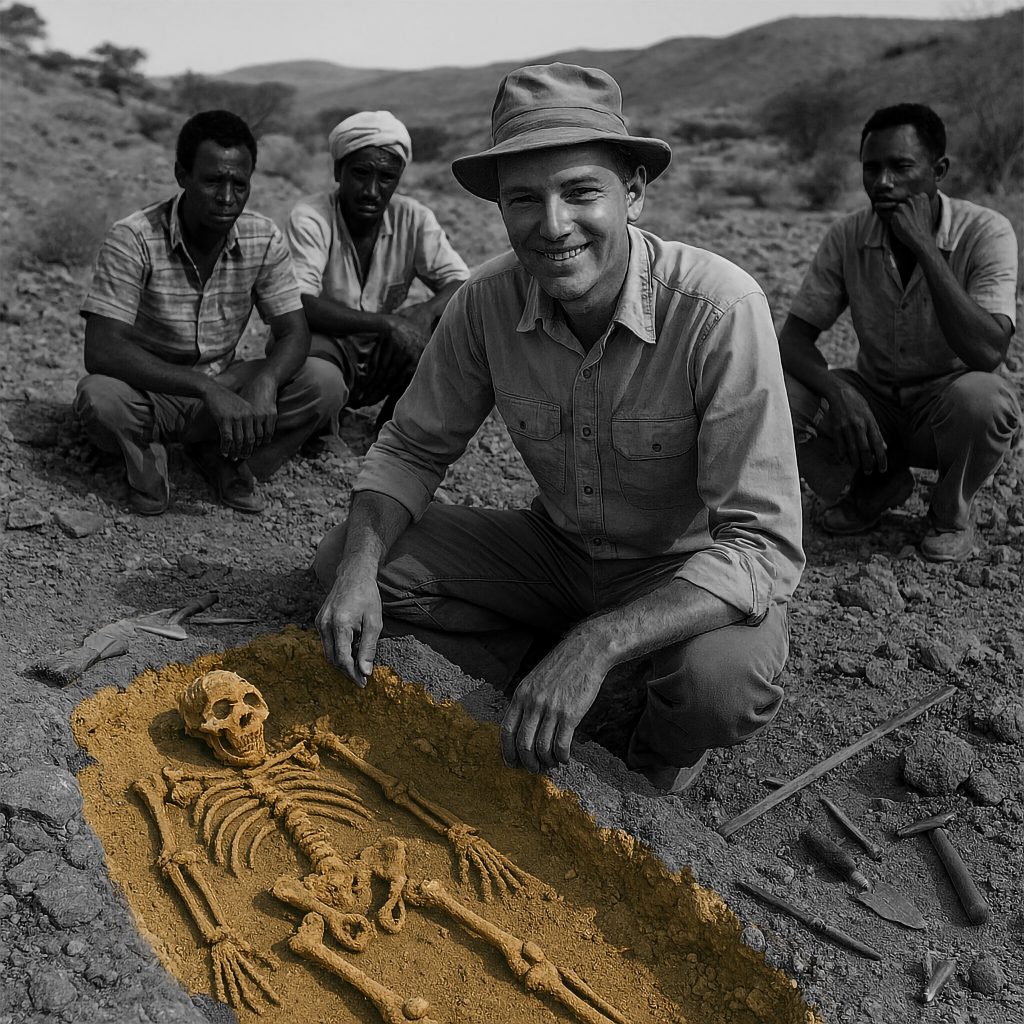
AL 288-1, commonly known as Lucy, is a collection of several hundred pieces of fossilized bone comprising 40 percent of the skeleton of a female of the hominin species Australopithecus afarensis. It was discovered in 1974 in Ethiopia, at Hadar, a site in the Awash Valley of the Afar Triangle, by Donald Johanson, a paleoanthropologist of the Cleveland Museum of Natural History. Lucy is an early australopithecine and is dated to about 3.2 million years ago. The skeleton presents a small skull akin to that of non-hominin apes, plus evidence of a walking-gait that was bipedal and upright, akin to that of humans (and other hominins); this combination supports the view of human evolution that bipedalism preceded increase in brain size. A 2016 study proposes that Australopithecus afarensis was, at least partly, tree-dwelling, though the extent of this is debated. We celebrate this feat of hominid research with an AI image of the find…


November 24
If you are interested what else happened on this day, please click on the calendar or press the button below: