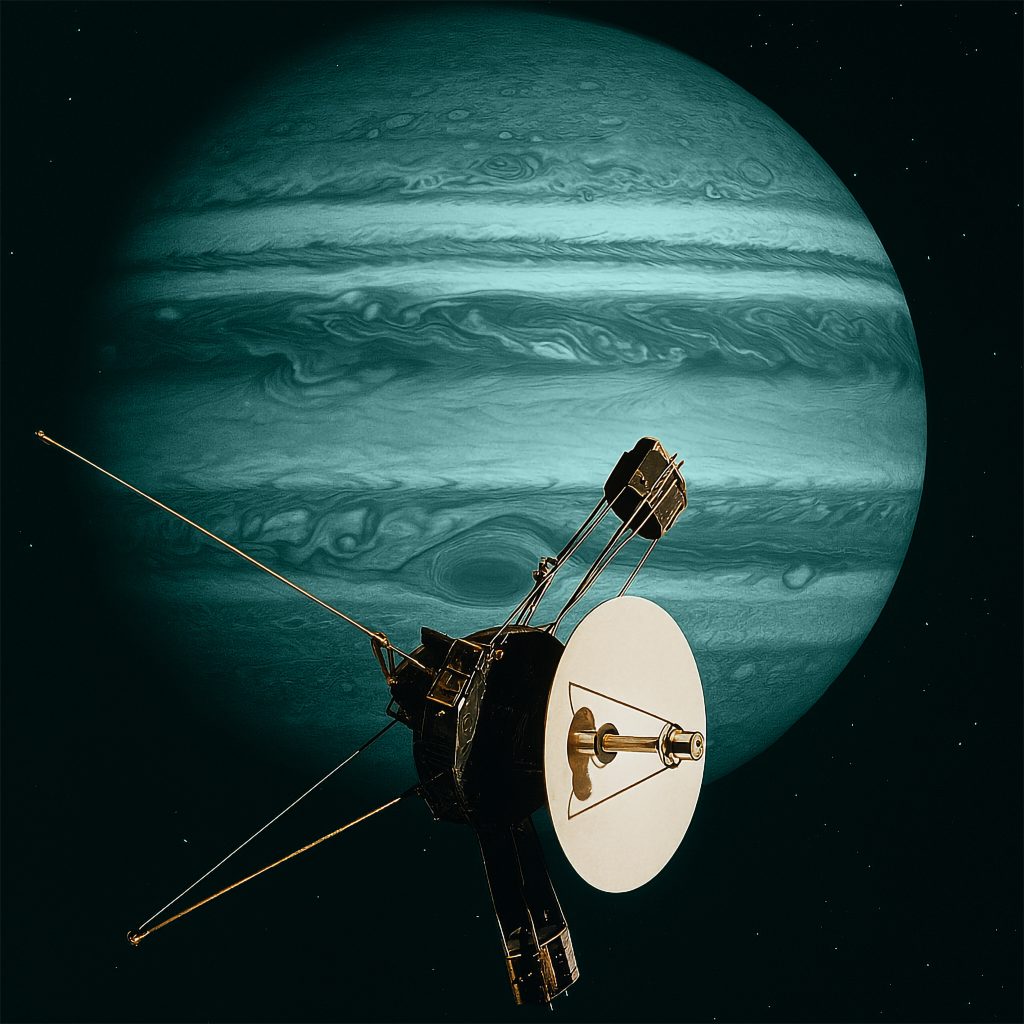
Pioneer 10 (originally designated Pioneer F) is a NASA space probe launched in 1972 that completed the first mission to the planet Jupiter. Pioneer 10 became the first of five artificial objects to achieve the escape velocity needed to leave the Solar System. This space exploration project was conducted by the NASA Ames Research Center in California. The space probe was manufactured by TRW Inc. Pioneer 10 was assembled around a hexagonal bus with a 2.74-meter (9 ft 0 in) diameter parabolic dish high-gain antenna, and the spacecraft was spin stabilised around the axis of the antenna. Its electric power was supplied by four radioisotope thermoelectric generators that provided a combined 155 watts at launch. It was launched on March 3, 1972, at 01:49:00 UTC (March 2 local time), by an Atlas-Centaur rocket from Cape Canaveral, Florida. Between July 15, 1972, and February 15, 1973, it became the first spacecraft to traverse the asteroid belt. Photography of Jupiter began on November 6, 1973, at a range of 25 million kilometres (16 million miles), and about 500 images were transmitted. The closest approach to the planet was on December 3, 1973, at a range of 132,252 kilometres (82,178 mi). During the mission, the on-board instruments were used to study the asteroid belt, the environment around Jupiter, the solar wind, cosmic rays, and eventually the far reaches of the Solar System and heliosphere. We celebrate this feat of exploration with an AI image of Pioneer 10 passing Jupiter …


December 3
If you are interested what else happened on this day, please click on the calendar or press the button below: