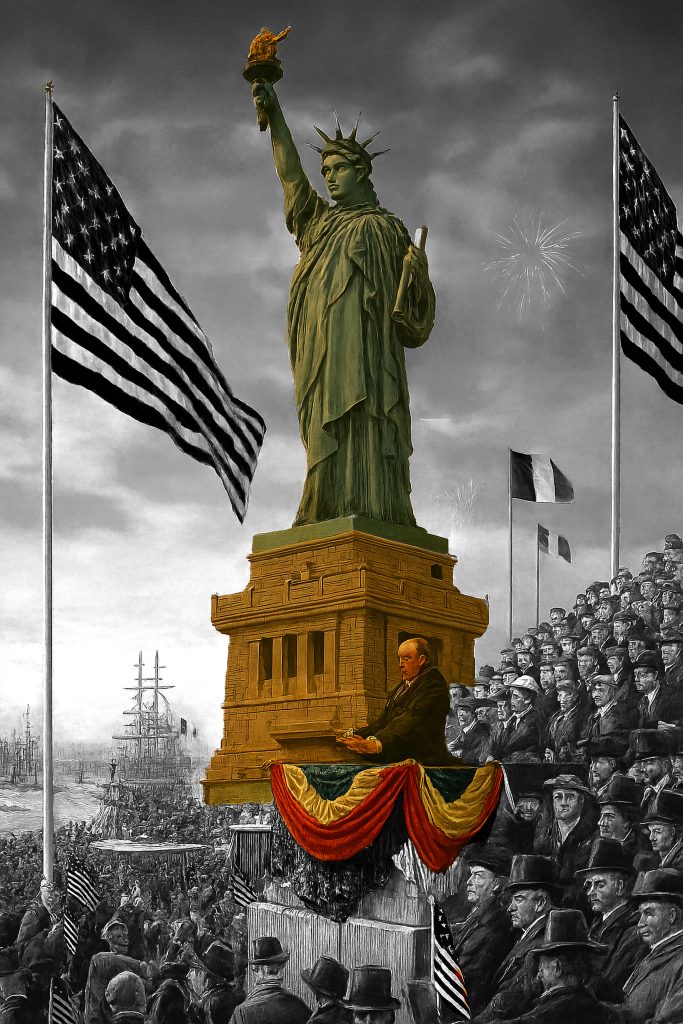
The idea for the Statue of Liberty was conceived in 1865, when the French historian and abolitionist Édouard de Laboulaye proposed a monument to commemorate the upcoming centennial of U.S. independence (1876), the perseverance of American democracy and the liberation of the nation’s slaves. The Franco-Prussian War delayed progress until 1875, when Laboulaye proposed that the people of France finance the statue and the United States provide the site and build the pedestal. Bartholdi completed the head and the torch-bearing arm before the statue was fully designed, and these pieces were exhibited for publicity at international expositions. The torch-bearing arm was displayed at the Centennial Exposition in Philadelphia in 1876, and in Madison Square Park in Manhattan from 1876 to 1882. Fundraising proved difficult, especially for the Americans, and by 1885 work on the pedestal was threatened by lack of funds. Publisher Joseph Pulitzer, of the New York World, started a drive for donations to finish the project and attracted more than 120,000 contributors, most of whom gave less than a dollar (equivalent to $35 in 2024). The statue was built in France, shipped overseas in crates, and assembled on the completed pedestal on what was then called Bedloe’s Island. The statue’s completion was marked by New York’s first ticker-tape parade and a dedication ceremony presided over by President Grover Cleveland.


October 28
If you are interested what else happened on this day, please click on the calendar or press the button below: